Drywall After a Roof Leak in Gainesville, FL: What to Dry, Cut, or Replace
September 23, 2025
Frequently Asked Questions
What is the unit price for new drywall?
$2.00 to $3.50 per square foot in 2026, hung and finished. Board, tape, mud, and sanding are in that range.
What adds the most cost?
Area first. Then finish level, ceiling height, and texture. Paint is priced apart in most bids.
How do I read a bid?
Each line should name the work and its price: board, hang, finish, texture. If a bid is one lump sum, ask for the lines.
What finish level do I need?
Level 4 is the norm for walls that get flat or eggshell paint. Level 5 is best under gloss paint or hard side light.
Do patches come with a firm price?
Yes, after the free check. Most patches are $250 to $900 based on size and texture work.
Which towns do you serve?
Gainesville, Newberry, Alachua, and High Springs. Each town page shows its own ranges and facts.
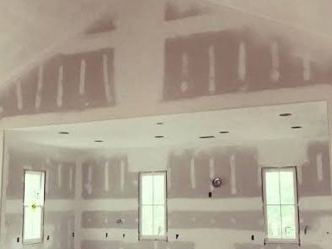
September is the heart of storm season in Gainesville, and the calls follow a pattern: a heavy afternoon storm, a drip through a ceiling, and a homeowner asking whether the brown ring on the drywall is a paint job or a tear-out. The answer depends on time and water, in that order.
Atlantic hurricane season runs June 1 through November 30, according to the National Oceanic and Atmospheric Administration, and Gainesville's share of that season is mostly rain — inches of it, sideways, finding every tired roof seam. This post is the order of operations we give people on the phone, the same one behind our water damage drywall repair work.
First: stop the water and start the clock
No drywall decision matters until the leak is stopped. A patched ceiling under an active leak is money thrown away. Once the roof is sealed, the clock starts: the U.S. Environmental Protection Agency advises drying wet materials within 24 to 48 hours to keep mold from taking hold, and mold can start growing on damp surfaces inside that same window.
In a Gainesville September, indoor air is already humid, so a wet ceiling does not dry on its own the way it might in January. Fans help. Air conditioning helps. A rented dehumidifier helps most. If the ceiling is bulging, stay out from under it — wet drywall gets heavy, and a soaked sheet can come down without much warning. Poke a small hole in the lowest point of the bulge with a screwdriver, with a bucket under it, to let the water out in a controlled way.
What can stay, and what has to go
Drywall that got damp on the surface and dried fast can often stay. The test is touch and smell: board that feels firm, with no softness when you press a thumb into it and no musty odor a few days later, is usually sound once the stain is sealed with a stain-blocking primer and repainted.
Board that stayed wet, feels spongy, sags between joists, or has visible mold growth on it should come out. Gypsum board is a paper-faced product; the paper is what mold feeds on, and cleaning the face does nothing about growth on the back side inside the wall cavity. Cut back to dry, firm material — pros often cut a clean rectangle to the nearest studs so the patch has solid backing, which is the same approach used on our drywall ceiling repair jobs.
The insulation question people forget
Above a ceiling, the insulation matters as much as the board. Wet fiberglass batts mat down and lose their insulating value, and they hold moisture against the back of the drywall for days. If the leak soaked the attic insulation, that section usually needs to come out and be replaced after everything dries. Skipping it is how a fixed ceiling grows a mold smell by Thanksgiving.
A short checklist for the first 48 hours
- Stop the leak or tarp the roof before anything else.
- Photograph the damage for your insurance file before you touch it.
- Move furniture and put a bucket under any bulge; drain bulges with a small hole.
- Run fans, air conditioning, and a dehumidifier in the room.
- Press-test the board after two days: firm can stay, spongy comes out.
- Do not paint over a stain until the board is fully dry and sealed with stain-blocking primer.
What the repair looks like once it is dry
Once the source is fixed and the cavity is dry, the repair is ordinary drywall work: cut the damaged board back to a clean rectangle, fit a new piece, tape, mud, sand, and prime with a stain-blocking primer before the finish paint. Small sections can be patched in a day, though the compound still needs its dry time between coats. Larger ceiling sections may need the insulation above replaced first, and the texture matched to the surrounding ceiling — orange peel and knockdown both — so the patch disappears instead of announcing itself as a smooth island.
Keep the photos and the roofer's invoice with your insurance paperwork. Storm-season leak repairs in Florida are exactly the kind of claim documentation insurers ask for, and a dated photo of the stain before the repair is worth more than a description after it.
And if the leak came from plumbing rather than the roof — a supply line or a drain in the ceiling — the same order holds, with a plumber in the roofer's place. The drywall does not care where the water came from; it only cares how long it stayed wet.
When the stain is more than a stain
If the wet area is bigger than a couple of feet across, if the ceiling sags, or if you can smell mold, have it looked at before you close anything up. Call (352) 649-3354 — we will tell you plainly which parts can be saved and which cannot, and the estimate is free and in writing.